martes, 20 de enero de 2015

Vivi's Internship

In the third year at my university we have the brilliant opportunity to take credits through an internship in community outreach in a developing country. I, of course, could not miss this opportunity and started looking for internships in South America, my native contingent that I love so much. Para La Tierra immediately offered me different options for my project and so I decided to travel to Paraguay. As part of my project I helped Becca and Jorge in their school visits and the starting of Futuro Paraguayo. Having the kids at the reserve and seeing their enthusiasm for nature was one of my highlights at Laguna Blanca. Starting from November, with the arrival of the first tourist groups I started taking surveys on the weekends, trying to find out what sort of tourist comes to the reserve and what their interests are. That meant working on Sundays while everyone else was enjoying free time, but sometimes I met interesting people and had a nice chat. I soon realised that Paraguayans don’t know much about nature and often aren’t interested, which makes it exciting when someone does! And those are the people I wanted to reach. People have to be fed with information, they don’t look for it, that is my main discovery with the interviews and the ecological station at Laguna Blanca has lot of potential for that. During the other days I followed other interns with their projects, learning about amphibians and reptiles, small mammals, birds, and bigger mammals (monkeys) at the reserve. I had the chance to expand my knowledge that way, and I am really grateful to everyone that helped me achieve that! During my last month I helped Becca with her project, together with Lore (a volunteer from Belgium) we went on daily walks in the Atlantic forest looking for the Capuchins. We ended up creating the “Wospers”, an ingenuous device for cutting down the wasp nests from the branches along our trails, which made our days adventurous. I can say it was a successful internship, it was good for my career, for myself (you grow a lot during these experiences!) and for my friend network, I made very important friends that I hopefully will see again somewhere. I send you all much love from Uruguay, where I am still trying to let go and get ready for a new, exciting semester in Zürich, Switzerland! CIAAAOOO Vivi Vivi Magistra Switzerland September-December 2014

Foraging Critters...my internship at PLT

Hi there, my name is Abi and I’m just finishing up my internship here at Para la Tierra. I’ve been asked to write a blog post about my time here. My project was originally going to compare the foraging habits of small mammals in areas of high and low human-presence; using seeds trays to determine the giving up density (GUD) and from that the perceived risk. Unfortunately, in the areas where that was possible, there weren’t enough small mammals foraging the trays for me to get sufficient results. Luckily, another intern (Holly) was regularly catching a variety of small mammals in Sherman traps as part of her project studying how a section of the Cerrado is recovering after a fire. Since wildlife living in a recovering habitat is often more vulnerable to the environment, I decided to look at abiotic factors, such as the average temperature and whether or not that affects the foraging levels each day, and I am currently analysing these results. Drinks around the fire and film nights were great fun in the evenings, as were the Saturday night parties. These parties could be birthday parties, or parties which charge entry to raise money for chicken coops or hospital bills. The people from local towns and villages set up a patch of land with speakers and lights, sell beer and dance. As a break from the reserve (and to renew the date stamp on my tourist visa) I’ve been on three trips around the country. The first was a trip to the capital city Asuncion with Holly, India and Vivi, the other three Interns. On the 18th November we went on a PLT group trip to the Chaco. The Chaco is described by some as a ‘green hell’ due to the extreme heat and humidity but despite this, or perhaps because of this, the wildlife is so uniquely varied and rich that we simply had to go for a look. We saw amazing wildlife that is unlikely to be seen on the reserve, the highlights for me included: Capybara, flamingos, armadillos, racoon, crab-eating fox, white-lipped peccaries and a fantastic number of bird species. My third trip took me to Iguazu falls in Argentina with India and Lore to see one of the wonders of the natural world. The falls were unbelievable, and we also got to see Itaipu dam, the second largest hydroelectric dam in the world.

lunes, 15 de diciembre de 2014

Chaco Trip Nov 2015

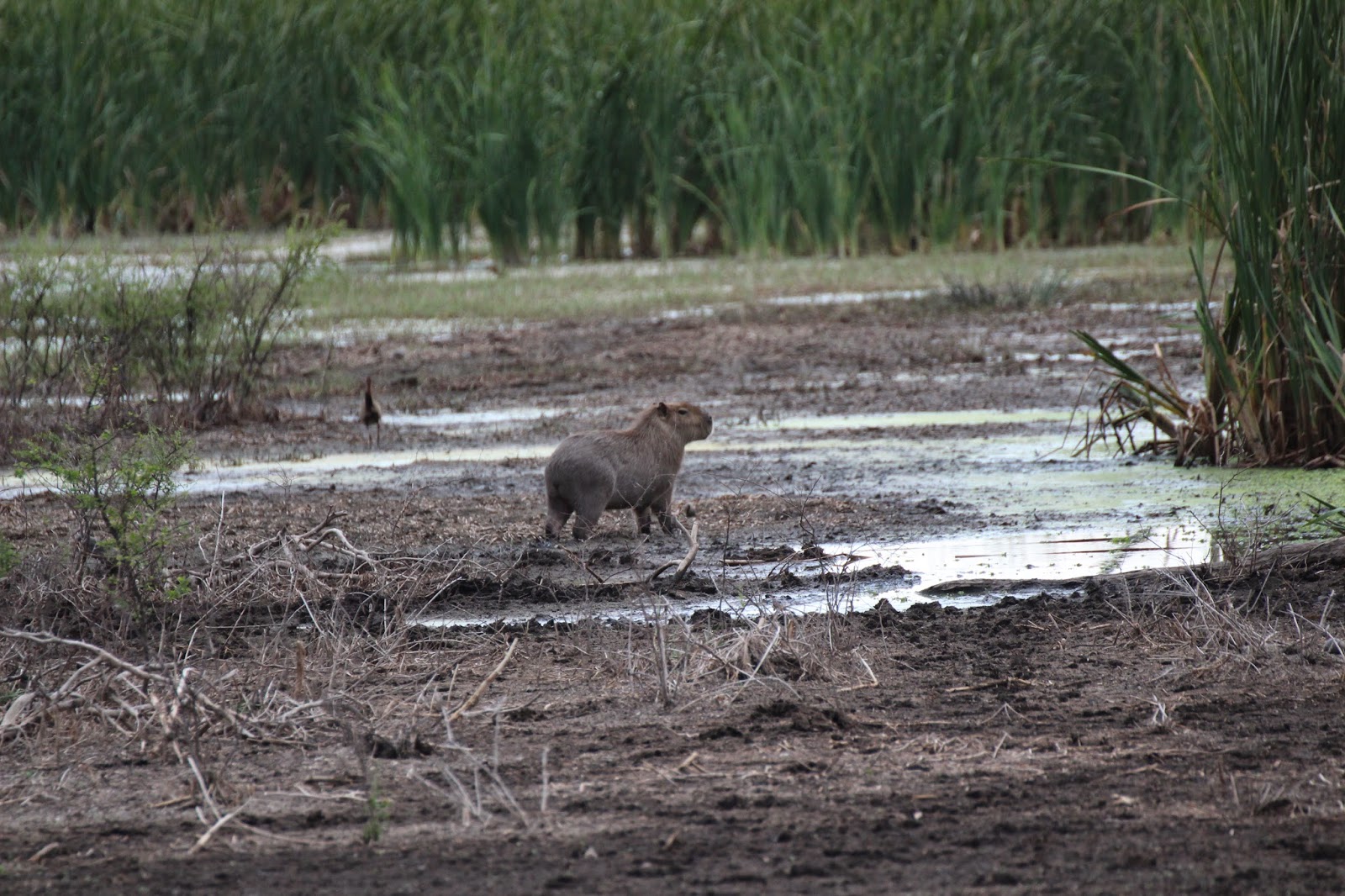
On the 18th November we at PLT took a trip to the semi-arid Chaco region of Paraguay. The Chaco is described by some as the ‘green hell’ due to the extreme heat and humidity but, despite this, or perhaps because of this, the wildlife is varied and rich. The difficult conditions make the Chaco the ‘last agricultural frontier’. It is virtually uninhabited even today with just a few large settlements and farms (mostly Mennonites) making it a haven for a lot of unique wildlife. Unfortunately now the area is threatened by development through cattle farming, improvements in agricultural techniques and the increased ease of access caused by the Trans-Chaco Highway. On the trip came staff members Joe and Becca. Along with them were the Interns and Volunteers: Holly, Abi, Vivi, India, and Lore. Our home for the three days was ‘Chaco Lodge’, a small house on a large estancia owned by a Mennonite Biology teacher who wishes to preserve much of the land for wildlife. An indigenous family live next door and they often wandered over to show us things they had found, such as an ovenbird nest. The amenities were rustic: food was whatever could be cooked in a pot hung over a fire (pasta), or cooked on a stick held over a fire (bread). We had to divide into two groups to get to Chaco Lodge, a car group and a bus group. The bus journey is slightly longer, from Santa Rosa to Asuncion and from there to Filadelfia (14 hours), where we were met by Joe. The drive from Filadelfia to Chaco Lodge was already the beginning of our adventure in the Chaco. Halfway to the Lodge we stopped when we spotted a dark figure on the road....a Capibara! Vivi’s hope for this trip was to see a Capibara, an impressive, giant rodent. Unfortunately, the individual found on the road was dead, and the carcass was collected by a passing car. We then settled into the house for our first night’s sleep. Amazingly, with air conditioning! The first morning we were excited to go and explore our new surroundings, and so we went for a walk down the trail hoping that it wouldn’t be too hot to see any wildlife. It was, but we did see lots of interesting footprints, which Becca taught us to identify. We saw the prints of a Tapir and Peccaries along the main path and, at a dried-up streambed of soft-mud, we saw the tiny prints of an unknown wild-kitten and the hand-like prints of a raccoon. Because of these, we decided that area would be the ideal spot for a camera trap and placed one there the following day. At lunchtime, we drove to a nearby salt lake nearby and witnessed some beautiful scenery. We walked on the sands and examined the evidence of the hot, drying temperatures: carcasses of fish and insects, which were scattered along the beach. Despite the seemingly-barren landscape, a heat-blurred pink line could be observed within the lake... FLAMINGOS! We climbed up onto a viewing platform in order to take some photographs. We then ate our picnic lunch surround by the sounds of parakeets which were nesting around the viewing platform. Our first day ended with a night drive after dinner. Anticipating some wildlife we went armed with our cameras. Siitting on the back of the car with a large spotlight, we drove slowly along searching for animals. We didn’t have long to wait. As Becca once said, you literally “fall over armadillos in the Chaco”! Several armadillos later, we’d all had a hold of one and taken a multitude of photographs and had much amusement in watching them scurry off back into the undergrowth. A racoon was spotted (much larger than most of us expected); a fox; a Geoffry’s cat and some deer. We even saw a skunk! Our final catch for the night was a little cartoon-like bright green tree frog, the Phyllomedusa sauvagii , which we spotted crossing the road. There were many frogs on the road, but this little guy was a particular favourite and you can see him in one of the photographs below. Finally, after a long and eventful first day in the Chaco we all fell into bed, alarms set for 5am the next day. Our other two mornings began with a group sunrise walk to some nearby tajamars. On route to the first tajamar we stumbled across a couple of mating red-footed tortoises (Geochelone carbonaria). We spent a short time watching the male struggle to get out of the puddle he was stuck in, and crossed our fingers as we left that the two would be reunited after having waddled off in opposite directions. As we reached the tajamar we noticed what looked like a stick floating on the surface, but in fact it was a caiman’s head! The head rapidly disappeared and we waited a while but unfortunately we were not lucky enough to get another sighting. Caiman build the entrances of their homes under the surface of the water and so can return to the safety of their home without having to resurface. We then headed off in the car to Campo Maria, a salt lake known for its multitude of bird species. Unfortunately, the road was washed away by torrential rain, forcing us to stop. Fortunately a Mennonite contact offered us shelter from the rain at his farm. Upon arrival we were greeted by a somewhat confused lady who said that we could relax on her porch. She seemed relieved when Vivi could speak German and after that she brought out coffee and cake for everyone. After a few hours of waiting and playing with her ridiculously cute dogs we suddenly heard her phone ring followed by hysterical laughter. It turned out we were at the wrong house and her neighbour had just rang to find out if she had us! Despite the weather, the day wasn’t a fail for seeing wildlife. We got our first look at Roseate Spoonbills and saw a Buff Necked Ibis and her chicks in a nest and, on the way back to Chaco Lodge, a herd of approximately 50 wild White Lipped Peccaries (complete with pigets!) crossed the road in front of the car. Our second day concluded with a super tasty dinner of burgers and chips, cooked outside over the fire. Some of the girls took advantage of the fire to dry their wet socks! We then had a cosy night in Chaco Lodge, listening to some impressive thunder. The second tajamar morning walk, on or final day in the Chaco, was very pleasant, and was mostly spent bird-watching. We saw a couple of Black-backed water-tyrants (Fluvicola albiventer), a pair of Wattled jacana’s (Jacana jacana) with their chick, two Grey-necked woodrail’s (Aramides cajanea), and a very cute little duck which was paddling around the tajamar, thoroughly enjoying its own company. On our walk back to the house we briefly saw some Red-crested cardinals (Paroaria coronate) and a woodpecker which was drilling holes in a large cactus that it appeared to be living inside. Later in the morning we went a walk to set out a camera trap for the owner of Chaco Lodge. Hopefully it will capture some interesting wildlife! Our final afternoon drive took us, successfully this time, to the salt lakes at Campo Maria. Driving along we saw a Jabiru, a Spoonbill, some Herons, and Buff-neck Ibis along with a lot of birds of prey and parakeets. Finally, passing near a pond, we spotted two Capibara. The excitement in the car was audible, people jumped out of the vehicle with their cameras ready. It was a great experience to see them. Our final night concluded with us witnessing some amazing lightning storms, from the safety of Chaco Lodge before we again all collapsed into bed, exhausted from the day’s excitement. Overall, our trip to the Chaco was very enjoyable, despite some rainy weather. All of the wildlife was spotted that was on each of our “wish lists”, amongst much more! The “green hell” is not such a “green hell” at all and we all have some fantastic and photographs to take home with us. A HUGE thank you to Joe and Becca for taking us all the way there and giving us such a great experience. Holly O’Donnell (Scotland) Abigail Harrison (England) Viviane Magistra Balz (Switzerland) India Robinson (England) Lore De Middeleer (Belgium)

martes, 9 de diciembre de 2014

PLT Welcomes Olga, our new Museum Curator

Hello, everybody! My name is Olga. And I’m the new museum curator here at PLT. I’ve come to Paraguay to avoid the long snowy winter of Russia, my homeland, and to see with my own eyes all the “exotic” animals I’ve read so much about. Well, it’s definitely warm here! And every day brings new species to discover. Sometimes directly to your room, as was the case yesterday with a giant tarantula spider making a tour around my suitcase, or a cute tree frog lost in a bathroom. As a curator I mostly work with maintenance of the museum collections and the addition of new specimens. The main project right now is the species inventory of two families of moths and some other insects. So far PLT has re-discovered a moth believed to be extinct and has found several species and even a whole genus not previously known to be present in Paraguay. This knowledge not only helps to better understand the Paraguayan nature, it also shows the high level of biodiversity at Laguna Blanca, and thus further supports the argument that this land needs to be protected. The PLT museum is open for visitors. To make it more educational and fun the team of PLT came up with some renovations and new exhibitions. One of the changes is a “mini-zoo”; a shelf with terrariums to show tourists and local children creatures that are usually hard to see due to their nocturnal lifestyle or small size. The terrariums are made and what’s left is to decorate them and find inhabitants: lizards, frogs and invertebrates. We plan to keep the animals only for a short amount of time and release them back into nature on a regular rotation. When it’s not too hot I like to go for a walk on one of tourist trails. I won’t call myself a birder, but it is nice to look for them. I leave you with birds of Laguna Blanca.

sábado, 1 de noviembre de 2014

"Futuro Paraguayo"

On the 22nd of October, 30 teenagers from the San Blas High School were invited to the reserve to take part in the first session of “Futuro Paraguayo” – Para La Tierra’s new natural science children’s club. Jorge and I are extremely lucky at the moment to have the assistance of PLT’s first community outreach intern, Vivi Magistra. Since Vivi arrived at the start of October we have carried out 3 lessons in Santa Barbara primary school (our current visits happening every second Monday) and a visit to the San Blas (two high school and three primary school classes). Last Wednesday marked the beginning of our new program that Vivi hopes to also offer to the children of tourists during the summer season. The day prior to the teenagers visit was spent planning. Our goal was to show the students as much of the reserve as possible and also take the opportunity to show off the PLT Natural History Museum providing a chance to see specimens of the reserves varied wildlife. All of the interns were roped into the preparations including: creating tokens of animals and collecting material from different habitats, opening pitfall traps in the Atlantic Forest, setting Sherman traps in the Cerrado, catching small fish in the lake and making sure GPS and camera batteries were charged. Everyone went to bed extremely early that night, though sleep did not come easily!! The next morning we woke at 05:30 to finish preparations. We were ready by 07:30 and thankfully had time to gulp some tea or coffee and at 8am we received the call – the students had arrived. Jorge welcomed the students to the reserve in the local language of Guarani. Everyone looked extremely excited as he explained how the day would work: the students would be split into three groups and each group would take part in an activity in a different part of the reserve. Between each activity there would be a 10-minute break where we would provide cold juice and then the groups would rotate. Activity one was lead by Jorge. He took the children on a tour of the museum, explaining the importance of the collection and showing examples of some of the species found in Laguna Blanca. One of the highlights for the children had to be the demonstration of scorpions under a blacklight (they glow bright green!) and the HUGE male and female tarantulas that Olga had caught in her pitfall traps. Outside the museum a game had been set up with four trays, each representing one of the reserves habitats: the lake, the Atlantic Forest, the Cerrado and the Transitional Forest. The children were given small animal tokens and had to match the species with its habitat. The museum tour ended with an explanation of the importance of camera trapping and Jorge then took the group for a walk down Arroyito trail and demonstrated how to set up a camera trap in the field. Vivi was in charge of Activity two: pitfall traps and GPS training. This activity began on the beach with a demonstration of how to use the handheld Garmin GPS units. The children were then given GPS’s and instructions to use them to reach a point (Destino 1) that had been marked the night before. For the first group, enthusiasm took over and they ended up completely lost in the seasonal pond! However, in the end all three groups made it to their destination: an open pitfall trapline. Vivi then explained how to install and check a pitfall trap, what creatures you can expect to catch and why you have to be cautious in case of catching spiders, scorpions or even a venomous snake! As I spend most of my days wandering around the Atlantic Forest it was a nice change of scenery for me to take Activity three: Sherman trapping in the Cerrado. We walked out to the Cerrado where Sherman traps had been laid the night before. I explained the use of Sherman traps and the importance of studying small mammals, using the Clyomys laticeps as an example. I then gave a short explanation of the importance of studying habitat as well as animal behavior and demonstrated the use of a quadrat before the children got to have a shot of throwing it. After each group had taken part in each activity we returned and they completed a short exam. Overall the answers were excellent and showed that everyone had not only been listening carefully during each activity but that they were also thinking for themselves and beginning to understand the importance of conserving Laguna Blanca. Overall, the day was a huge success thanks to the hard work of everyone involved and we look forward to bringing the high school children back to the reserve in November! Until next time, Becca

viernes, 24 de octubre de 2014

Karina's Trip to India

Having visited India for the 2012 Rolex Awards for Enterprise ceremony in New Delhi, I was excited to return in July this year. The difference between this visit and my last, was that I this time I was not just another tourist to the Golden Triangle, I was there to build on my skills in NGO management, network with other like-minded biologists and conservationists, and explore new solutions to universal community and conservation challenges. I spent ten days near Pune with my Earth Expeditions Masters class, hosted by the Applied Environmental Research Foundation (AERF); three days at the Agumbe Rainforest Research Station followed by three days at the Madras Crocodile Bank Trust, both run by Romulus Whitaker, a 2008 Rolex Associate Laureate; then finally a visit to the home of Arun Krishnamurthy, my friend and fellow 2012 Rolex Young Laureate. With AERF I visited local sacred groves, each of which was protected by local communities, and linked to a flagship species. While this idea was born organically in India, it’s a technique employed by conservation organisations across the world, including Para La Tierra in Paraguay, which is represented by the endangered White-winged Nightjar. AERF do a wonderful job of involving communities in conservation, ensuring that local voices are heard and their views valued when making forest management decisions. I had the opportunity to meet with leaders of remote communities, discovering that conservation in India has as many spiritual links as scientific ones, a concept which, unfortunately, seems to be fading quickly in Paraguay. At Agumbe, I joined interns and volunteers studying skink behaviour. In much the same way as interns at Para La Tierra, their studies contribute to protecting the area and all of the biodiversity within it, in addition to training them in conservation biology. The Croc Bank was founded specifically to conserve and protect endemic species of reptiles, but now educates thousands of people in reptile conservation every week, providing funding for research at Agumbe, among other projects. In addition to witnessing conservation of Indian biodiversity in action, I had the privilege of speaking with a number of inspiring individuals, each doing their part for conservation. Dr. Chris Myres is the founder and director of Project Dragonfly, an award-winning program which links people from around the globe through science, education and the environment. Chris shared his passion with me: to change the way children are educated. He believes firmly that everything can be traced back to “Inquiry Community Voice”, the mantra of Project Dragonfly. Talking to him renewed my motivation to work hard for what I am passionate about, and reminded me that wide networks of like-minded individuals have the power to drive change, much like the Rolex Awards network. My second inspiring encounter was with Romulus Whitaker, founder of the Madras Crocodile Bank Trust. A very cool and collected Rom welcomed me to his farm near Chennai for lunch and a chat, reminding me of my life in Paraguay for the first time since I’d arrived in India. Perceived as a foreigner in his own country, he reminded me that you can’t do anything without help from friends, and that involving local people is key. He told me “successful people are visionaries; they see the past and the future and apply it to the present”. I’ve been implementing his advice in my own life and work since returning to Paraguay. My stay with Arun Krishnamurthy opened my eyes to another way of solving problems, again through engaging people and communities. Arun’s fervour for his “beautiful India” and its people manifests itself through proactive cleaning of waste dumped at lakes in and around Chennai. I was kept in awe as I witnessed him leveraging teams of hundreds of volunteers, animating the streets, and engaging the media for his cause. It’s clear that Arun’s infectious energy gives him the power to bring people together to fight what looked like an almost impossible battle, for something they all believe in. This learning experience renewed my energy to connect people and nature, and helped me to realise that by sharing each other’s successes and solutions, whether in India, Paraguay or anywhere in between, we can tackle conservation and education on a global scale. Karina Atkinson, Scotland Executive Director Para La Tierra

martes, 23 de septiembre de 2014

A Taman-what???

One the 18th of August we received a call from Malvina – the owner of Laguna Blanca. She had been contacted that morning by the fiscalia (a branch of the police) in Santa Rosa. A family in a community near Santa Rosa called Lima had discovered a tamandua hiding in their garden and had called the police to come and deal with it. Now I can almost hear you asking, as did the volunteers, a taman-WHAT?? A tamandua is a small, arboreal anteater. They are significantly smaller than the giant anteater of the Cerrado and they live in Transitional Forest and Atlantic Forest of Laguna Blanca. They are white with a black “vest” pattern on their fur. They are extremely strong and have large claws used for breaking open termite mounds, digging through hard ground and ripping open rotting logs. The volunteers and I had been in Asuncion the night before and the trip back seemed to take much longer than the normal 5 hours as we all crossed our fingers that we would get to see and release the tamandua in the reserve. We were in luck. The police brought the tamandua to the reserve in a small wooden crate early in the afternoon and when we arrived at the reserve in the afternoon, the tamandua was sound asleep in the chicken coop. It turned out to a female and Jorge described her as “muy pansa” – meaning she had a great big belly! This made me suspect/hope that she may in fact have been pregnant! Tamandua can be nocturnal or diurnal – meaning that they can move either during the day or the night and do not tend to have a strict pattern to their activity. Since it was a hot day we decided to let her sleep until dusk and then release her into the Transitional Forest. As the sun began to set Jorge and I entered the chicken coop to put her back in her box to take her to be released in the Transitional Forest. I was rather apprehensive as we entered, since I have no hands-on experience with any anteater species, and didn’t know whether or not she would be aggressive. This may seem silly as, like the giant anteater, tamandua’s have long, soft mouths that lack teeth but with a long tongue used to collect ants and termites. However, it was not biting I was afraid of. The little female was equipped with large formidable claws and I definitely did not fancy being scratched or having to treat anyone’s wounds! Thankfully my fears were unfounded, as aggression didn’t seem to be a big part of her personality. She continued to sleep, curled into a little ball and only began making hisses of mild protest when Jorge levered her into her box again. Though small, tamanduas are solid muscle and the box wasn’t very light. Jorge and I took a side each and walked her over to the Para La Tierra house where we got the rest of the volunteers and tied up the very confused dogs so they couldn’t follow. We all headed down the Mbopi trail towards the forest. By this point she was completely awake and looking for an escape. She began to walk up and down in the small box making it even harder to carry. Then she started ripping at the wood with her large claws. About halfway down Mbopi, the tamandua decided she had had enough. With one great pull, she broke the wooden box and clambered out onto the path. She made no attempt to run away. She turned to look at us for a minute while everyone’s cameras snapped wildly, then trundled off slowly into the forest. We followed. She climbed into a tree giving everyone the perfect opportunity for some great pictures. Though she hissed at us at first she soon came down from the tree and walked further into the forest where she immediately began foraging – settling in to her new home. Hopefully we will see her again on one of our camera traps soon, maybe even with babies! It definitely was a unique and exciting experience to get so close to one of Laguna Blanca’s more elusive inhabitants! Until next time, Becca

lunes, 25 de agosto de 2014

There and Back Again: A Toad's Tale

My name is Bridget Gladden, you probably do not know me. I am a student at the Ohio State University studying zoology, conservation science, and Spanish, and this is my story. The snow outside still sat stubbornly on the ground. The wind blew fiercely, mocking all who tried to step outside. It was November. The first snow storm in a wave of cold had settled on Ohio State University. While staring at the slightly ominous sky, I allowed my mind to drift to another place, one filled with warmth and sunlight. My plans for the summer had not yet been solidified, but I know that I was going somewhere that did not know snow. South America was my destination, and research was my plan. It was simply every other detail that still had to be worked out. In the midst of deciding my next action, I recalled a gentleman who had spoken to my ecology class earlier that year. His name was Joseph Sarvary. He talked of a place in Paraguay called Laguna Blanca where the sun touches the lake every morning and the birds sing after the rain. That was where I wanted to go. I riffled through my papers to find the information. Before I had formulated another thought, I was contacting the head of the organization, Karina Atkinson. What began as thoughts of escape quickly turned into the opportunity of a life time. Arriving at Laguna Blanca was no easy feat with delayed flights, unusual transportation methods in Asuncion, and a lack of any sort of fluency in Spanish, but travel never is simple. It was only moments after my arrival that I felt at ease, even at home. There were certainly aspects that I was unaccustomed to like the necessity to throw away toilet paper instead of flush it, the chickens that wander everywhere or the hanging of laundry on lines. Over the next month though, I began to make some of the best friends of my life. I learned unique customs that set Paraguay apart from other countries, and of course, I advanced in both knowledge and ability through my research. My plan before I arrived was to continue my interest of malformations in amphibians that had developed through research at school. However, due to the lack of time at the field site and limited equipment, I began to focus my attention towards other options. At first, I was disappointed with my inability to settle on one idea. I wanted to change the world, one frog at a time. My uncertainty did afford me one thing: time. I had time to see the reserve from several points of view, time to survey areas that had not yet been surveyed, time to gather intellect on other possible projects, and time to enjoy my temporary life here. As time wore on, my idea sharpened and began to take shape. It was certainly not without guidance. I was going to research the homing abilities of a rather comical animal, the Rococo Toad. Past researchers have done numerous studies on homing abilities. Burmese Pythons had been discovered to travel forty kilometers to find their home again. Salmon travel thousands of miles back to their place of birth to lay their eggs. Rococo Toads, to this point, have not had this ability researched. So, each night I search for toads, collecting them in buckets and placing them around the reserve to see if they will come home. My hypothesis was that the home is where the light is for the toads. Those that cannot see it will not return. So far, the data seems to support that hypothesis. Whether my data is publishable or not, the experience has changed me as a person, for the better. I cannot yet say how this change will translate upon my return, but I know now that my thought of the people and places around me will have been altered. Living in a new culture, a new life, has caused me to newly appreciate my life at home. I do not think it is possible to thank the people who have supported me and pushed me forward on this trip enough. Each day here is truly a new one. It may have started as a dream from a frosty land far away, as clear as I am standing on this soil, that dream has turned into a reality. So, thank you all for the trip of a lifetime. Bridget Gladden, USA PLT Intern May-August 2014

lunes, 21 de julio de 2014

Why go to Paraguay?!

I have been living and working with Para La Tierra in Laguna Blanca in Paraguay for nearly a year and a half now. When I talk to people at home the questions I get still make me laugh: “Where are you again?", “How are you liking things in Panama?” and my personal favorite “Paraguay, wow! It must be amazing to live in Asia!”. While these things are extremely funny to hear and almost harder to believe it does highlight an issue: not enough people know about Paraguay and what an incredible country this is. I’ll start with the facts: Paraguay is a landlocked country in the middle of South America, roughly the size of California and with a population of about 6.7 million (2012). The currency is the Paraguayan Guarani and the two official languages are Spanish and Guarani (an indigenous language spoken by a large percentage of the population – also one of the most wonderfully weird languages I have ever had the privilege of listening to). In spite of Paraguay’s colorful history dominated by dictators and political instability I have found this country to be one of the friendliest, most welcoming places I have ever lived. The country is separated into two halves: The Chaco and The Oriental sides. On the Oriental side you can find the endangered Atlantic Forest and Cerrado habitats and on the other is the beautiful, intimidating and nearly impenetrable Chaco. That’s some general Paraguay knowledge for you, now I want to share with you the reasons that you should come stay with us in Laguna Blanca in the heart of this wonderful, hidden gem of South America. Reserva Natural Laguna Blanca is located in Departamento San Pedro in the East of Paraguay. I have been lucky to travel to some extremely beautiful places in my life but there is something magical about this reserve that has forever guaranteed it a special place in my heart. Covering only 804ha the reserve contains: a fragment of Atlantic Forest, home to two species of monkeys, deer, peccaries, coatis, tayra and a recently discovered addition of capybara!; the Cerrado, with an incredible array of birdlife that will take your breath away; the Transitional Forest, a weird mix of the previous two habitats with its own stunning biodiversity and of course, the crystal clear lake, perfect for drinking, swimming and catching green anacondas! If you come and join us you will be able to explore all of these exceptional places for yourself. For a biologist, one of the most exciting things about Paraguay is the fact that it is always over looked and forgotten. As a result, there are new discoveries to be made – who knows what you might find lurking in the bottom of a pitfall trap or around the next bend in a trail through the Atlantic Forest. While exploring this strange new world, you will be making friends that I can promise you will last a lifetime. Whether its lying in the lake to escape the summer sun, checking a bat net together, squishing through the “gunk” in the lake reeds trying to catch small fish, dancing the night away barefoot in the red dirt at a party in one of the local communities or huddling together around a fire to try and keep out the winter chill you will create bonds that will stand the test of time. I haven’t just felt those bonds building with the people who I have been fortunate enough to meet here, but with the country itself. I have felt it creep slowly under my skin and into my heart, and I know that it will do the same for anyone brave enough to step outside their comfort zone and take a chance to come down and volunteer with Para La Tierra. Hopefully sharing my experiences in Paraguay will change the questions I am asked the next time I am in Scotland. I don’t want to hear “Why would you go to Paraguay?” anymore, I want to hear “How can I get to Paraguay!!”. Until next time! Becca

lunes, 23 de junio de 2014

Back to School

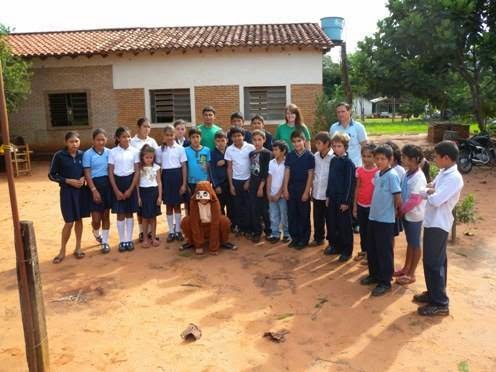
Nervous does not begin to describe how I was feeling when I went to my bed on Thursday the 10th of April. The next day Jorge and myself were heading to the Santa Barbara Primary School to begin teaching a curriculum of biology and environmental education to children aged between 8 and 11 years old. Since coming to Paraguay I have learnt a great deal of Spanish and can easily understand and make myself understood. However, the butterflies going crazy in my stomach were giving me the fear that I was going to get up in front of a class full of children, forget not only how to speak Spanish, but speak AT ALL, and completely embarrass myself. At 7:30am on Friday morning we left for school armed with the projector, screen, laptops and a secret weapon. Jorge and I set up the projector and screen while the kids filed into the classroom looking excited, if not slightly confused. Our photographer, Kevin, flitted around the back of the class taking photos (that will be posted on the PLT facebook page soon). After carefully avoiding eye contact with everyone and anyone I had no choice, it was time to take a big deep breath, and start the lesson. Surprisingly I found that as soon as I started talking all of my nerves disappeared. Due to a huge storm the day and night before and a sky threatening more rain, the class wasn’t full and the children that were there were watching us in silence with undivided attention – clearly willing and excited to learn something new. The topic of our first lesson was the importance of Reserva Natural Laguna Blanca and in particular, the Atlantic Forest. We talked about how special the forest was and how endangered. Then, how important the forest is for my personal favorites – the capuchins and the howler monkeys. After a half hour talk about the forest it was time to unleash the secret weapon. We were going to go outside and play a small game, AND because the children had been so good and listened so well, maybe there would be a special visitor outside! Everybody went outside and each child’s face lit up as they saw one of our volunteers – Mathilde from France – dressed in a monkey costume in the middle of the playground. Lots of happy screaming and shouting ensued as she chased them around the yard. Four trees in opposite corners of the yard had been named after each of the reserves habitats – the Atlantic Forest, the Cerrado, the Transitional Forest and the Lake. When Jorge counted to three, the children had to run to a corner before Mathilde the Monkey could catch them and whisk them off to the jungle! Once everyone had chosen a corner, Mathilde closed her eyes and picked a habitat and Jorge and I asked the children in that corner questions about the habitat. Then everyone came back to the center and the questions were put to the entire group. After a group photo, we all went back inside to enforce our take home messages. I told the children how they were lucky that they still had a chance to start to care for Paraguay’s forests before it was too late and there was nothing left and Jorge told them how Mathilde the Monkey had come to show them that wild animals are our friends and we should care for their homes. Kevin then handed out a lollipop for each child and we left definitely buzzing at the success of our first lesson. This lesson was just the beginning of the PLT Primate Team’s Educational Outreach Program. We will be going back to school twice a month to teach the children about the environment, conservation and basic biology, and I for one, can’t wait! Becca

viernes, 30 de mayo de 2014

New Arrival at Para La Tierra

Hey there PLT followers! My name’s Kevin Siri and for the next 8 months, I’ll be working at Laguna Blanca Nature Reserve as the new Volunteer Coordinator and Museum Curator. I’ll also be involved with this blog to keep you all updated on the latest news from PLT. First of all, a little bit about myself. I’m half Irish, half French grew up across the Middle East as my dad worked for UNRWA, the UN agency which takes care of Palestinian refugee camps. I was educated in French schools until the age of 11 and then finished my school education in Norn Iron (AKA Northern Ireland to the non-Irish…). A move to Scotland beckoned after that to study Environmental Science. Ever since I was a kid, I was really into wildlife so it just made sense to carry that passion on through uni, in the hope of working in that sector once I was finished. I completed that degree this October past through the Open University whilst living and working in Glasgow with my fiancée. I’ve already had some experience in environmental businesses but this has primarily been on the ecotourism side of the spectrum whilst I was working towards my degree. I spent a summer working for a tour company in Lebanon setting up a hike leader training course and doing research into possible avenues for the expansion of ecotourism across Lebanon. Then, more recently, I worked with an ecolodge in Uganda to establish a community-based coffee processing project which would increase the revenue from the local village’s crops; whilst also helping with the running of the lodge. Once my degree was completed, the next step was putting what I’d learnt into practice so started applying for jobs in the sector. As I’m sure most of you know, it turned out to be a nightmare! Everyone was asking for 2 years’ experience as a project manager, a Masters, fluency in Klingon, etc, etc… You know the drill! But then, on one of my frequent trawls through ads for environmental jobs, a wee ad caught my eye. “Museum Curator and Volunteer Coordinator”, Location: Paraguay. Now, to be honest, apart from watching France knock their national team out of the ’98 World Cup, I knew close to nothing about Paraguay but, after a read through the ad and a look at the PLT website, it seemed like a really interesting position with an organisation that was doing some great work so the logical thing was to apply; although, considering how my previous applications had gone, I wasn’t overly optimistic. However, lo and behold, a week or so later, I had an email asking me to take part in the interview process. And there began the journey that landed me here, writing this blog in the middle of a very wet Paraguayan wilderness! I arrived last night after bussing and quad biking my way up from Asuncion and Laguna Blanca has far surpassed my expectations! Where else can you wake up to an amazing view over the lake and the songs of hundreds of tropical birds?!? Everyone has been so welcoming and it just feels so much more relaxed than any of my other first days on a job! That’s not to say that there’s not a lot of work to be done! There are a load of projects that I’ll be involved with and just can’t wait to get stuck in; whether it be finding scorpions by torchlight (!), working in the museum or just helping volunteers enjoy their stay; to name but a few…. Speaking of which, there’s a moth light that needs checking so I’ll be off for now but I’ll be back soon to keep you all updated on life out here. Wish me luck! Kevin

lunes, 7 de abril de 2014

Laguna Blanca 2: Return of the Birdman

I spent three days in 2012 and three months with Para La Tierra (PLT) at Laguna Blanca (LB) last year and had the most amazing experience. I returned to London and became immersed in my regular job with the Metropolitan Police but knew I would return someday! I applied for extended leave during March and April 2014. Once the leave was approved I began preparing for my return. I am a birder, twitcher, or whatever other label can be put on my hobby. Many people look at me and cannot work out the combination of the two, many think I am winding them up when I tell them about my feathered friends. But in truth being a Cop and a birder complement each other perfectly and by this I mean the chaos of my daily working life needs to be offset with complete relaxation with the bonus of my desire to travel to relatively unknown destinations thrown in. This is where PLT enter the room and take a huge step forward. Four years ago a scientific research station was set up at LB. The area is one of outstanding natural beauty and is probably one of the best kept secrets in South America. Interns and volunteers can come and complete projects in their field of expertise with a team of dedicated scientists at hand to assist in maximising the potential of such a project. Where do I fit into the above you may ask? I do not have a scientific background but I have a passion that burns inside for interaction with my feathered friends. With the assistance of the staff at PLT I have been guided along the path to thinking about the science behind what began as a hobby! I have been taught to apply scientific techniques to my bird watching and I feel that the term ornithologist is becoming a more appropriate description of my activities. I have the greatest admiration for the work that is carried out by the PLT team and sometimes wonder if the staff appreciates the difference that they make within the community! This is most evident when you venture outside the reserve and you are welcomed with open arms wherever you go. The PLT house brings together people from all over the world and presents a great opportunity to broaden ones horizons and to make life-long friends! There is also the possibility that you could find a new species for the reserve or even for science! I have assisted with other onsite projects which have broadened my knowledge of the beautiful surroundings I have the privilege of walking in each day. If you have not visited LB I can only suggest you download a map and look up Laguna Blanca San Pedro Dept Paraguay then get planning! You never know you may even bump into a crazy birdman because he has every intention of returning! Kevin Guest Para La Tierra Volunteer March-May 2014 (London

viernes, 14 de marzo de 2014

Monkey Business

Over the last few months the Para La Tierra Primate Project has been evolving. As we spend more and more time with the capuchin groups we are starting to see changes in their behavior. Several times, volunteers and myself have been fortunate enough to witness natural behaviors such as play and foraging. This time last year, this would never have been possible as the monkeys attention would always have been focused directly on us – performing threat displays and alarm calling. Of course, this still happens but there are definite signs that the groups are becoming used to the presence of the Primate Team. We have recently managed to produce the first map of how the capuchins are using the reserve. The color of the map shows how often the capuchins are found in that area – the red being the places they are found the most (see below). This has allowed the Primate Project to move in an exciting new direction. We now run different studies of the capuchin population – each one designed to teach different primatological field techniques. Learning about primates from books and lectures is very interesting, but studying them in their natural environment is something completely different. For me, the main goal of the PLT Primate Project is to give people the chance to learn about primatology while having the excitement of seeing these amazing animals in the wild. The best part of my job is getting to watch the wonder on a new volunteer’s face the first time they see the small yellow and brown monkeys leaping from tree to tree. If you come down to Paraguay and join us, you will spend your days in the Atlantic Forest – one of the world’s most biodiverse, and most endangered habitats. Six days a week, the Primate Team walk the Atlantic Forest trails searching for the monkeys. If you are lucky, not only will you get to see our noisy, curious and intelligent capuchins but maybe you will get a glimpse of our elusive Black-&-Gold Howler monkey females or maybe even be the first to find a male. When you find the monkeys you will collect data using different methods for our range of projects. You will search the system of Atlantic Forest trails looking for the capuchin troops. During this search you will learn the best methods for locating wild primates in their natural habitats both through visual and audio cues. Once the group has been located you will perform a scan of every visible monkey and record what individuals you can see (if you can identify different individuals), age, sex and behavior so that we can see how their behavior changes as they become more habituated. You will record vocalizations using a directional microphone and participate in a cognitive study using camera traps. As well as all of this you will spend time cutting trails in the forest, take part in discussions of scientific literature and recent developments in primatology and other areas of biology. It’s far from all “work” and no play at PLT. Volunteering at Laguna Blanca your friends will become your temporary family and friendships built here will last a lifetime. You can kayak across the lake and watch the spectacular sunset, dance barefoot in the red sand at a party in one of the local communities (an experience almost impossible to describe to someone who has never been here) or simply just sit on the porch sharing a beer and stories. Come down to Laguna Blanca and experience all of this for yourself! www.paralatierra.org/volunteering Until next time, Becca

jueves, 16 de enero de 2014

One Year in Paraguay

In January 2013 I packed my bags and headed to Edinburgh Airport, ready to embark on one of the biggest adventures of my life. I was moving to Paraguay – a country I knew almost nothing about, where everyone spoke two languages I didn’t know – to start my new job as the Primate Project Leader for Para La Tierra. Looking back at the last year, wondering how the time could have passed so fast, I am finding it hard to choose my highlights. One moment I will never forget is the first time I ever saw the monkeys. Walking down the road in the Atlantic Forest and realizing that there were two capuchins sitting in the trees at the side watching us. As we ran into the trails I tried to jump a fallen tree, covered in vines. I failed – miserably. My feet got caught in the vines and I instinctively grabbed my camera, meaning that I flew head first into a bush. Thankfully I am far more surefooted in the forest these days! One of the most challenging parts of my job is finding the monkeys. As we have not yet fitted any individuals with GPS collars we search the forest each morning hoping to come across the group. One of the best parts of my job, and something that has not changed at all over the course of the year, is the feeling of awe and excitement that I feel when we finally find the monkeys. To watch these incredibly intelligent creatures, free in a small island of their natural habitat makes me feel so privileged. This feeling was completely overwhelming the day we discovered the Black and Gold Howler monkeys. After walking through the forest in the cold and the rain for two hours and looking into the trees and seeing a species that everybody told me had not been seen in the reserve for years was one of the most breathtaking moments of my life. I burst into tears and had to lean against a tree to be able to stand – if the volunteers hadn’t thought I was crazy before this definitely confirmed it!! Two more moments that stand out for me was the day that we discovered that the forest has far more monkeys than we originally suspected. I had been told that there was a group of around 8 individuals and 2 extra group males. This was all I had observed until one day in the North Atlantic Forest with Anna. The forest exploded with capuchins. As we ran down separate trails, all thoughts of wasps and spider webs abandoned, we shouted breathlessly down the phones the numbers we could see. I had 9 in my sight, Anna had 11. This included mothers carrying infants. The second day was the day we discovered that there is two separate groups in the reserve and at the same time confirmed that the howlers were still present. It is not just the work that has made the last year so special. I have made friends that I know I will have forever. With experiences ranging from all floating the lake because it is too hot to even sit out of the water to huddling together round a fire under piles of blankets trying desperately to warm up, from driving an hour in the middle of the night to pick up and deliver a coffin to learning how to drive a motorbike for the first time wearing flip flops and shorts with Jorge sitting on the back holding three machetes every moment – good or bad, easy or hard – has been incredible. I have learned new skills, the biggest being that I can now speak Spanish, something I never thought I would be able to do. I have been fortunate enough to have been able to witness and embrace an entirely new culture that I could never have even imagined and still don’t know how to explain to those who have never visited rural Paraguay. As 2014 began with watching fireworks on the beach before dancing barefoot in the red dirt until 5 30am with a group of the best people I have ever met, I thought about how much has changed over the last year. I am bubbling with excitement thinking about what this year holds for the Primate Project. Take the risk, try something new and come down to Paraguay and share this amazing place with us. Happy New Year everyone! Until next time, Becca

jueves, 2 de enero de 2014

Life as a Monkey-Person by Johanna Wahlbeck (Sweden)

I have now spent more than one month at Reserva Natural Laguna Blanca as a volunteer for the primate project and would like to share some of my experiences: Every weekday I get up in the dawn, make breakfast and eat while I watch the sun rise above the beautiful lake. This morning it was the most beautiful sunrise I’ve seen yet with the sky colouring the whole lake pink. When you start a day like that it doesn’t matter what time it is or how tired you are, you’re ready for the day to begin (cheesy but true) and it begins with a walk in the Atlantic forest in the search for monkeys. When I first arrived here I didn’t see the capuchin monkeys for a couple of days but when I finally saw them it was amazing, they were quite close, looking at us, threatening us and feeding. We stayed with them for about 20 minutes before they disappeared in the forest. The second time I saw them was even better, Becca suddenly turned and pointed at something among the trees and there they were travelling towards the road. We hurried the same direction to get a better look at them and when reaching the road we saw them cross from one forest fragment to another. As we were approaching them a juvenile was about to cross and hesitated when seeing us. It was all fuzzy without any tufts and looked at us without making any alarm calls. It was the cutest thing I’ve ever seen. After seeing the monkeys for a while a couple of days goes by without seeing them, even though intense searching is being performed. And when you’re on the edge of getting really frustrated about not knowing where the monkeys are Becca will suddenly point and exclaim “There they are!” and all the hours of searching is rewarded by a quick and exciting sighting that makes it all worth it. The primate project is very new, we only recently were able to identify the monkeys, something that I found really rewarding. I and Anna, a fellow volunteer, looked at all the pictures we had of the monkeys and looked for characteristics in the face and body. Then we named the different individuals after Greek gods and mythical characters. During this time I discovered a favourite monkey of mine, the one named Cupid, name being based on the fact that his face is shaped as a heart (I’m romantic like that). Being here has taught me a lot about work as a biologist and about scientific work. Not only do I now know what it may be like to work as a primatologist, I’ve also had an insight in the fields of ornithology and herpetology. I’ve learnt how to use a GPS in the field and I’ve improved my sense of direction to the level that I now know every trail in the forest by heart. Some body work is also needed when working in the fields. We’ve been using machetes to cut trails in the forest to walk on when looking for the monkeys. This part always makes you feel like Rambo, Lara Croft or some other hard-core fictional character. When I’m not searching for monkeys, or getting in character as Rambo, I am enjoying the company of all the amazing people I am sharing this experience with, swimming in the lake, kayaking, learning Spanish, watching a movie or just hanging out. Some weekends there are parties to go to and a couple of weekends ago Para la Tierra hosted a party to raise money for the Female Empowerment Project. It was so much fun, great atmosphere with loud music and good food, drinks and company. I ate very good empanadas, drank beer and danced until I couldn’t dance anymore. The evenings at the reserve are as magical as the mornings and the sunsets as colourful as the sunrises. The other night I stayed up with two of my friends and fellow interns watching the stars. In fifteen minutes I saw five starfalls. However, I didn’t know what to wish for since I am so fully satisfied and happy with my life here. I couldn’t wish for more and I wish for everyone to feel the same way as I do being here, so come join us as a volunteer and see for yourself what I’m talking about. Love Johanna.

martes, 17 de diciembre de 2013

Our flagship species the enigmatic White-winged Nightjar

The area around Reserva Natural Laguna Blanca is home to some very special animals. One of these is the critically endangered White-winged Nightjar. This nocturnal bird is restricted to the Cerrado belt of the Neotropical region and it only occurs at three breeding sites in the world. One of these populations can be found in Brazil and the other two are within Paraguay. There have been two additional sightings at a location in Bolivia in 1987 and 2003, however, a breeding population is yet to be found. The habitat that the Nightjar prefers is a type of Cerrado (Savannah) called wet campo. It is dominated by grasses and small shrubs with scattered trees and anthills. The Nightjars have a preference for sites near wetlands as they use them for hunting insects. Males set up territories around the anthills and can be found perched on them or on a nearby small shrub. In the bright evenings of the breeding season they take to the skies and display to attract females. They show off the white on the wings that gives them their common name. Females and juvenile’s wings and tails lack this white coloration. Unfortunately, the transformation of the White-winged Nightjar’s natural habitat has it battling for survival. Some of the threats they face are; habitat conversion to plantations, uncontrolled fires, over grazing, habitat disturbance by cattle and invasive grasses. The Cerrado is the second largest biome in South America and it is rapidly disappearing. More than two thirds has been altered in the last 50 years, and the situation has been described as ‘one of the greatest ecological disasters in South America’. In Paraguay, this biome is restricted to small patches of the north east corner of the country. Most of the Cerrado habitat is found on private farmland, and there are only several Cerrado sites that are protected. Our population is found on a property just north of the reserve. There are approximately 30 individuals on site. Unfortunately the land is being converted into Eucalyptus plantations, and it is a race against time to prevent the population from being wiped out. On a brighter note, the recent discovery by the PLT team of a second population on a nearby property gives us hope for the future. In the last two weeks we have made two trips to go and see the Nightjars. On both occasions we were fortunate to see a number of both sexes. They are very approachable with a spotlight and this is another reason why they are vulnerable to extinction. They share their home with other threatened species and we were fortunate enough to see some of them on these trips. Three species of threatened birds, the Lesser Nothura, Black-masked Finch and Cock-tailed Tyrant also rely on this habitat for their survival, and face the same fate as the White-winged Nightjar if the habitat destruction continues. We were very fortunate to come across a Maned Wolf on the first trip, which was a first for everyone who was present. These elusive and rare mammals are threatened throughout their range, so it was a privilege to chance upon one. The one thing all these animals have in common is that they are habitat specialists and do not cope well with unnatural changes to their environment. We recently got some very good news that one of our team members Joseph Sarvary has received funding from the Rufford Foundation to conduct a study on the Nightjars in the area. He will be looking to answer four questions. The exact population size, home range and foraging behaviour, mating and fledgling behaviour and a complete census of the bird species in the area. This work is vital for our understanding of the bird and its habitat. The data will build a case for the future protection of the area. If you would like to take part in helping Joe with his project to save this endangered species, you can contact us on www.paralatierra.org. Until next time. JP

lunes, 25 de noviembre de 2013

UPDATE: Primate News

The 20th November 2013 turned out to be a very exciting day for the Primate Team at PLT. We are very happy to confirm for the first time that there are two separate groups of Azara’s capuchins (Sapajus cay) living in the reserve’s Atlantic Forest fragment and there are still Black and Gold howler monkeys inside the reserve. The Primate Team right now consists of two volunteers (Anna, Ireland and Johanna, Sweden), one intern (Christina, Denmark) and myself. We had been searching without luck for just over a week but this is the nature of working with such small, fast, arboreal animals so we didn’t loose faith and we persevered. And it was worth it! As we walked through the forest I looked up. There they were: three adult capuchins in the trees about 250m to our left. As we ran to the next fork in the trails a small juvenile scuttled up the tree right in front of us. Christina and I took one trail and Anna and Johanna circled round on another. After following the monkeys for about half an hour we walked back to find the others, heard a rustle and saw the silhouette of a monkey off to our left. As we watched, the monkey began to move from behind the branches and my suspicions were raised – it was enormous. Then as it walked out onto an exposed branch I realized why: we were looking at a female howler monkey! Then just when I thought the morning couldn’t get any better I received a phone call from Griselda. She asked me if I had found the monkeys because she was watching loads of them (6) cross the road. I said yes we had found them to which she replied “ok so you are in the south forest”. We weren’t. We were in the north, roughly a kilometer from where she was watching more capuchins. Confirmation for the first time that there is more than one family group living in Reserva Natural Laguna Blanca!! Come and join us in Paraguay and learn about primatology through field work with these amazing creatures – www.paralatierra.org/volunteer

miércoles, 20 de noviembre de 2013

Party Time for Chickens!

One of the main aims of Para la Tierra is to support the communities closest to Reserva Natural Laguna Blanca. The biggest community outreach project that we run is the Female Empowerment Project. Funded by the Rolex Award for Enterprise, this project provided three communities surrounding the reserve with chicken houses (gallineros) and incubators. The purpose of this project is to give the women of the communities a chance to financially contribute to their families through raising and selling chickens. To raise money to push the project forward PLT and the communities of San Jorge and San Fransisco threw a party in San Jorge. After two weeks of careful planning Saturday the 16th of November finally arrived – and it was pouring with rain. We patiently waited out the morning, fingers and toes crossed that the rain would stop. By 1pm the rain seemed to be beginning to fizzle out and Karina, JP, Jorge and myself headed out to San Jorge to begin to set up for the football tournament. After dropping off Karina and JP, Jorge and I began the first of several runs to collect everything necessary for the party. The first stop was San Fransisco to collect the women and lots of ice! Then it was back to the reserve for the cool boxes for the beer. While waiting for the guards to load the boxes I received a phone call for Karina. Due to the rain no one had turned up for the football and it was time to call up the troops! Mike, Greg and Nathan were loaded into the back of the car with the cool boxes and we raced back to San Jorge. Teaming up with JP the boys began the football tournament. Slowly but surely people began to show up. Karina and myself headed back to the reserve to bring the girls and by the time we returned there was a small game going on. Karina and I set up the bar while Jorge and Antonio began the beer sales at the side of the football game. After an hour of playing in the heat and humidity the boys had attracted a crowd of 20-30 people and when the game was over they returned to the bar extremely red-faced, dirty and sweaty but having had a great time! The boys left to shower and we were hit by hurdle number 2 – the man we had hired to bring a giant speaker system and run the music for the party refused to come because of the rain. With the party teetering on the edge of cancellation Karina came to the rescue and negotiated that a man from the neighboring house bring his small speaker system and we use that. When this wasn’t loud enough Griselda and I raced back to her house to bring her sound system. Everything was set. The rain had stopped. We held our breath and waited for people to arrive. As we waited we noticed motorbikes pulling up, and then leaving again. Now the volunteers really stepped up and saved the day. With no-one else on the dance floor the group got up and started the party! Anna, Kath and Vicki stood at the door selling beer to attract people inside, Johanna, Nathan, Greg, Christina and Mike danced with the local children and by 10pm the party was bouncing. The volunteers and JP danced the night away while Karina, Jorge and myself ran the bar and Conce DJ’ed. Bingo and a raffle broke up the party and gave everyone a much-needed chance to sit down and cool off. Just when we thought the party was starting to wind down around 2am Mike made the night of the Paraguayans by doing “the worm”. Not to be outdone this quickly escalated into a dance off. Girls vs boys. Karina and me against Mike and one of the Paraguayan guys. The boys went first and as we watched we knew we had no chance but we went for it anyway! As we hit the floor, the music stopped! A rather embarrassing but hilarious end to what had been an amazing night. Though the final figures aren’t in yet it is looking like the party was not only a great success in that everyone had a fantastic time but each community has also raised enough money to push the project forward. Thanks again to all our amazing volunteers who made the night. If you want to come out and join in the fun and make a difference while doing it check out www.paralatierra.org. Becca

miércoles, 13 de noviembre de 2013

Encarnacion and Tirol

This past week Greg and I spent a few days in southern Paraguay in the city of Encarnaciόn. The reason for our trip was to visit Paul Smith, PLT’s scientific co-ordinator and founder of Fauna Paraguay. We had collected a few interesting species of frogs at Laguna Blanca that needed DNA analysis to determine their species status. While we were in the area we also wanted to explore the city and visit a nearby large tract of near pristine Atlantic Forest at Hotel Tirol. Greg is our new butterfly intern at RNLB. He is full of enthusiasm and has an outstanding gift to draw illustrations of wildlife from photographs. He decided that it would be great to join me on the trip to firstly meet Paul, and secondly to try find some interesting wildlife at Hotel Tirol. Encarnaciόn is a growing city that is on the north shore of the mighty Rio Parana. This is a beautiful river that unfortunately was dammed in the past, destroying a lot of biodiversity. Never the less the city is moving forward and has a lot going for it. The recent development of a promenade and beach is a major attraction, as well as some fine dining and amazing architecture. Once a year in February the city holds a major carnival that attracts people from all over the world. The first two days were spent with Paul. After analysing our frogs with a local Argentinian professor, we decided on a whim to explore a religious sanctuary on the east of the city. The sanctuary has some great views over the river to the Argentinian side. It was a very warm afternoon so wildlife was not plentiful. We did manage however to see lots of Eastern Collared Spiny Lizard (Tropidurus torquatus) on the walls, and a few birds including Hook-billed Kite, Dark-billed Cuckoo and Rufous Gnateater. That evening we were taken to a local marsh to try and find some frogs. The marsh was unfortunately polluted, but even so two species of adaptable frogs called from the reed beds. We watched males of the Dwarf Tree Frog (Dendropsophus nanus) and Purple-barred Tree Frog (Hypsiboas raniceps) trying to attract nearby females. It’s a sad story though knowing what the eventual outcome for this population will be. After getting our fill of the city, it was time to visit Hotel Tirol. Paul accompanied us for a few hours on our first evening. Our main target was to find and photograph the Schmidt’s Stream Frog (Crossodactylus schmidti). This species is only known from a small, fast flowing stream at this one site in Paraguay. We wasted no time, signed into our room, put our bags down and headed for the valley. We were very determined to find this species, and our efforts paid off when three were found within the first hour. These frogs are very sensitive to change. Without the fast flowing, clear water they would have disappeared a long time ago. The next day we spent time searching the grounds around the hotel. There were plenty of butterflies out that kept both of us occupied for hours. We lifted a log along one of the many well defined paths to find a very rare worm lizard (Amphisbaena darwinii) lying beneath it. These worm lizards spend most of their lives beneath the ground surface only getting pushed up after heavy rains. We spent time on the stream trying to find more Schmidt’s Stream Frog’s with no success but we did happen to come across a Sepia Snake (Thamnodynastes strigatus) probably also hunting for the frog that was eluding us. The following morning it was time to pack our bags and prepare for the long journey back home to Laguna Blanca. While waiting for the bus outside the hotel entrance, I saw a teenager across the road throwing a stone into the grass. I instantly ran towards him to see what the boy had found. To my surprise he picked up a huge Black Tegu lizard (Tupinambis merianae) and threw it onto the road. The lizard was badly wounded from the rock, but still tried to get away. I watched as one of my beloved reptiles got kicked continuously and then put under the boy’s bike to finish him off. The whole time the boy had a smile on his face, he seemed proud of his achievement. He tied the Tegu onto the back of his bike and went to show some nearby people that congratulated him. Unfortunately this ioccurs here in Paraguay and in a lot of other places around the world. Many wildlife populations have dropped significantly because of habitat destruction, pollution, overhunting and needless killing. I am not sure what the teenager did with his prize, but it is a scary thought knowing that the dwindling populations of wildlife within the country lie in the hands of youngsters like this. Para La Tierra’s mission is to protect threatened habitats and its inhabitants. We are working hard to try to educate the future generation about the plight of nature and how we can try conserve it in the interest of the local people. Come join us to help us understand this beautiful country that much more so we can make Paraguay a better place for the future. Until next time. JP

lunes, 28 de octubre de 2013

The Big Brained Primates of Laguna Blanca

In terms of intelligence, capuchin monkeys (Sapajus and Cebus spp) pretty much trump every other primate species (apart from humans!) on the continent of South America. The resident monkeys found in Laguna Blanca’s 414ha Atlantic Forest fragment are no exception!! There are thought to be between 12 and 14 individuals living within the reserve. There is one family group who are currently being habituated by the primate team volunteers and myself. Until recently when the monkeys were located within the humid, winding trails of the forest observers were treated to elaborate displays of alarm calls, fear grimacing (when the teeth are exposed like a smile and the eyebrows raised) and branch shaking. Encounters with the monkeys are brief but still breath taking and leave your heart racing with excitement. Last week the PLT Primate Team, right now consisting of Anna (a long term volunteer from Ireland who completed the same Primatology MRes as me) and myself, experienced the most exciting two hours of my 9 months chasing monkeys in Paraguay. The day began at 5 45am with the 30-minute walk to the South Atlantic Forest. Normally we take the motoloco (the bright red, incredibly fun, temperamental trike) it had died the day before so we began with a walk. We entered trail 1 and began to walk extremely slowly, taking extra care not to make too much noise on the carpet of dead, crunchy leaves. Usual procedure when we find the monkeys is to immediately make our presence known, if the monkeys don’t see you it is impossible for them to become habituated to researcher presence. On this day (and I couldn’t tell you why) I decided I wanted to sneak up on them and try and watch them for a while before announcing our presence. We reached the junctions of trails 1 and E – and heard a loud crash to our right. Monkeys. Painfully slowly – when every part of me wanted to run after the sound in case we missed them – we crept towards the crash. We didn’t hear another one. As we arrived at trail G and turned down a loud, hollow knocking sound greeted us. My heart sank thinking the monkeys had gone and all we could hear was a woodpecker. As we stole down trail G we looked up. Monos. The family group was in the tree in front of us. I quite literally stopped breathing as I realized what we were seeing. The hollow knocking sound was the monkeys. They were holding hard fruit in their hands and smashing it off the tree trunk in order to open it. Anna and I nearly fell over each other in desperation to get the camera out of the bag and start filming. This remarkable behavior not only perfectly displays the capuchins remarkable dexterity but also their incredible problem solving ability. For two hours we crawled around the ground trying to find the best view of the group, at one point I sat on a nest of biting ants but refused to move as I had a particularly good spot to film from!!! The next day we went out again the next day, this time with Emma as well. As we walked quietly along trail 3 towards the tree we had seen them feeding in before we heard the knocking. This time not only did we manage to film and photograph the fruit cracking behavior but also begging behavior from the younger monkeys!!! After about 45 minutes we were rumbled. The alarm calling began and the group vanished. We went to the bottom of the tree to collect some of the fruit that had been dropped. As we stood under the tree discussing what we had seen we heard a chirp and a crash behind us. Ka’i. Turning around we were faced with the sub-adult male of the group. Sitting about 3 feet above our head he was calling and displaying, generally making a grand show of himself. This is decoy behavior. I’m ashamed to say I fall for it a lot. As one member of the group comes close and displays loudly to draw observer attention, the others make a stealthy get away. Sometimes I think these monkeys are too smart for their own good!! Until next time, Becca