lunes, 15 de diciembre de 2014
Chaco Trip Nov 2015
On the 18th November we at PLT took a trip to the semi-arid Chaco region of Paraguay. The Chaco is described by some as the ‘green hell’ due to the extreme heat and humidity but, despite this, or perhaps because of this, the wildlife is varied and rich. The difficult conditions make the Chaco the ‘last agricultural frontier’. It is virtually uninhabited even today with just a few large settlements and farms (mostly Mennonites) making it a haven for a lot of unique wildlife. Unfortunately now the area is threatened by development through cattle farming, improvements in agricultural techniques and the increased ease of access caused by the Trans-Chaco Highway.
On the trip came staff members Joe and Becca. Along with them were the Interns and Volunteers: Holly, Abi, Vivi, India, and Lore. Our home for the three days was ‘Chaco Lodge’, a small house on a large estancia owned by a Mennonite Biology teacher who wishes to preserve much of the land for wildlife. An indigenous family live next door and they often wandered over to show us things they had found, such as an ovenbird nest. The amenities were rustic: food was whatever could be cooked in a pot hung over a fire (pasta), or cooked on a stick held over a fire (bread).
We had to divide into two groups to get to Chaco Lodge, a car group and a bus group. The bus journey is slightly longer, from Santa Rosa to Asuncion and from there to Filadelfia (14 hours), where we were met by Joe. The drive from Filadelfia to Chaco Lodge was already the beginning of our adventure in the Chaco. Halfway to the Lodge we stopped when we spotted a dark figure on the road....a Capibara! Vivi’s hope for this trip was to see a Capibara, an impressive, giant rodent. Unfortunately, the individual found on the road was dead, and the carcass was collected by a passing car. We then settled into the house for our first night’s sleep. Amazingly, with air conditioning!
The first morning we were excited to go and explore our new surroundings, and so we went for a walk down the trail hoping that it wouldn’t be too hot to see any wildlife. It was, but we did see lots of interesting footprints, which Becca taught us to identify. We saw the prints of a Tapir and Peccaries along the main path and, at a dried-up streambed of soft-mud, we saw the tiny prints of an unknown wild-kitten and the hand-like prints of a raccoon. Because of these, we decided that area would be the ideal spot for a camera trap and placed one there the following day.
At lunchtime, we drove to a nearby salt lake nearby and witnessed some beautiful scenery. We walked on the sands and examined the evidence of the hot, drying temperatures: carcasses of fish and insects, which were scattered along the beach. Despite the seemingly-barren landscape, a heat-blurred pink line could be observed within the lake... FLAMINGOS! We climbed up onto a viewing platform in order to take some photographs. We then ate our picnic lunch surround by the sounds of parakeets which were nesting around the viewing platform.
Our first day ended with a night drive after dinner. Anticipating some wildlife we went armed with our cameras. Siitting on the back of the car with a large spotlight, we drove slowly along searching for animals. We didn’t have long to wait. As Becca once said, you literally “fall over armadillos in the Chaco”! Several armadillos later, we’d all had a hold of one and taken a multitude of photographs and had much amusement in watching them scurry off back into the undergrowth. A racoon was spotted (much larger than most of us expected); a fox; a Geoffry’s cat and some deer. We even saw a skunk!
Our final catch for the night was a little cartoon-like bright green tree frog, the Phyllomedusa sauvagii , which we spotted crossing the road. There were many frogs on the road, but this little guy was a particular favourite and you can see him in one of the photographs below. Finally, after a long and eventful first day in the Chaco we all fell into bed, alarms set for 5am the next day.
Our other two mornings began with a group sunrise walk to some nearby tajamars. On route to the first tajamar we stumbled across a couple of mating red-footed tortoises (Geochelone carbonaria). We spent a short time watching the male struggle to get out of the puddle he was stuck in, and crossed our fingers as we left that the two would be reunited after having waddled off in opposite directions. As we reached the tajamar we noticed what looked like a stick floating on the surface, but in fact it was a caiman’s head! The head rapidly disappeared and we waited a while but unfortunately we were not lucky enough to get another sighting. Caiman build the entrances of their homes under the surface of the water and so can return to the safety of their home without having to resurface.
We then headed off in the car to Campo Maria, a salt lake known for its multitude of bird species. Unfortunately, the road was washed away by torrential rain, forcing us to stop. Fortunately a Mennonite contact offered us shelter from the rain at his farm. Upon arrival we were greeted by a somewhat confused lady who said that we could relax on her porch. She seemed relieved when Vivi could speak German and after that she brought out coffee and cake for everyone. After a few hours of waiting and playing with her ridiculously cute dogs we suddenly heard her phone ring followed by hysterical laughter. It turned out we were at the wrong house and her neighbour had just rang to find out if she had us!
Despite the weather, the day wasn’t a fail for seeing wildlife. We got our first look at Roseate Spoonbills and saw a Buff Necked Ibis and her chicks in a nest and, on the way back to Chaco Lodge, a herd of approximately 50 wild White Lipped Peccaries (complete with pigets!) crossed the road in front of the car.
Our second day concluded with a super tasty dinner of burgers and chips, cooked outside over the fire. Some of the girls took advantage of the fire to dry their wet socks! We then had a cosy night in Chaco Lodge, listening to some impressive thunder.
The second tajamar morning walk, on or final day in the Chaco, was very pleasant, and was mostly spent bird-watching. We saw a couple of Black-backed water-tyrants (Fluvicola albiventer), a pair of Wattled jacana’s (Jacana jacana) with their chick, two Grey-necked woodrail’s (Aramides cajanea), and a very cute little duck which was paddling around the tajamar, thoroughly enjoying its own company. On our walk back to the house we briefly saw some Red-crested cardinals (Paroaria coronate) and a woodpecker which was drilling holes in a large cactus that it appeared to be living inside. Later in the morning we went a walk to set out a camera trap for the owner of Chaco Lodge. Hopefully it will capture some interesting wildlife!
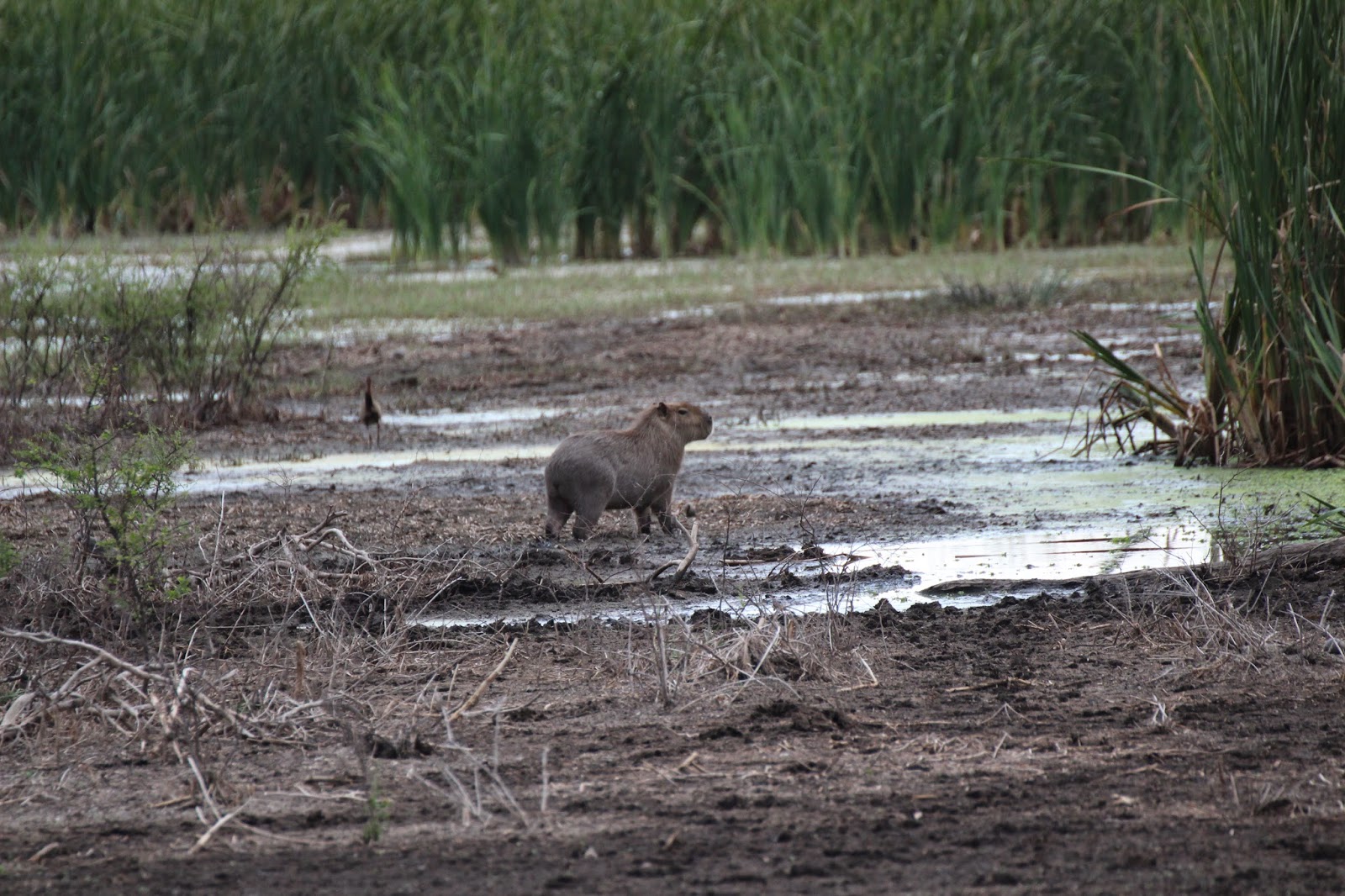
Our final afternoon drive took us, successfully this time, to the salt lakes at Campo Maria. Driving along we saw a Jabiru, a Spoonbill, some Herons, and Buff-neck Ibis along with a lot of birds of prey and parakeets. Finally, passing near a pond, we spotted two Capibara. The excitement in the car was audible, people jumped out of the vehicle with their cameras ready. It was a great experience to see them.
Our final night concluded with us witnessing some amazing lightning storms, from the safety of Chaco Lodge before we again all collapsed into bed, exhausted from the day’s excitement.
Overall, our trip to the Chaco was very enjoyable, despite some rainy weather. All of the wildlife was spotted that was on each of our “wish lists”, amongst much more! The “green hell” is not such a “green hell” at all and we all have some fantastic and photographs to take home with us.
A HUGE thank you to Joe and Becca for taking us all the way there and giving us such a great experience.
Holly O’Donnell (Scotland)
Abigail Harrison (England)
Viviane Magistra Balz (Switzerland)
India Robinson (England)
Lore De Middeleer (Belgium)


martes, 9 de diciembre de 2014
PLT Welcomes Olga, our new Museum Curator
Hello, everybody!
My name is Olga. And I’m the new museum curator here at PLT.
I’ve come to Paraguay to avoid the long snowy winter of Russia, my homeland, and to see with my own eyes all the “exotic” animals I’ve read so much about. Well, it’s definitely warm here! And every day brings new species to discover. Sometimes directly to your room, as was the case yesterday with a giant tarantula spider making a tour around my suitcase, or a cute tree frog lost in a bathroom.
As a curator I mostly work with maintenance of the museum collections and the addition of new specimens. The main project right now is the species inventory of two families of moths and some other insects. So far PLT has re-discovered a moth believed to be extinct and has found several species and even a whole genus not previously known to be present in Paraguay. This knowledge not only helps to better understand the Paraguayan nature, it also shows the high level of biodiversity at Laguna Blanca, and thus further supports the argument that this land needs to be protected.
The PLT museum is open for visitors. To make it more educational and fun the team of PLT came up with some renovations and new exhibitions. One of the changes is a “mini-zoo”; a shelf with terrariums to show tourists and local children creatures that are usually hard to see due to their nocturnal lifestyle or small size. The terrariums are made and what’s left is to decorate them and find inhabitants: lizards, frogs and invertebrates. We plan to keep the animals only for a short amount of time and release them back into nature on a regular rotation.
When it’s not too hot I like to go for a walk on one of tourist trails. I won’t call myself a birder, but it is nice to look for them. I leave you with birds of Laguna Blanca.


sábado, 1 de noviembre de 2014
"Futuro Paraguayo"
On the 22nd of October, 30 teenagers from the San Blas High School were invited to the reserve to take part in the first session of “Futuro Paraguayo” – Para La Tierra’s new natural science children’s club. Jorge and I are extremely lucky at the moment to have the assistance of PLT’s first community outreach intern, Vivi Magistra. Since Vivi arrived at the start of October we have carried out 3 lessons in Santa Barbara primary school (our current visits happening every second Monday) and a visit to the San Blas (two high school and three primary school classes). Last Wednesday marked the beginning of our new program that Vivi hopes to also offer to the children of tourists during the summer season.
The day prior to the teenagers visit was spent planning. Our goal was to show the students as much of the reserve as possible and also take the opportunity to show off the PLT Natural History Museum providing a chance to see specimens of the reserves varied wildlife. All of the interns were roped into the preparations including: creating tokens of animals and collecting material from different habitats, opening pitfall traps in the Atlantic Forest, setting Sherman traps in the Cerrado, catching small fish in the lake and making sure GPS and camera batteries were charged. Everyone went to bed extremely early that night, though sleep did not come easily!!
The next morning we woke at 05:30 to finish preparations. We were ready by 07:30 and thankfully had time to gulp some tea or coffee and at 8am we received the call – the students had arrived. Jorge welcomed the students to the reserve in the local language of Guarani. Everyone looked extremely excited as he explained how the day would work: the students would be split into three groups and each group would take part in an activity in a different part of the reserve. Between each activity there would be a 10-minute break where we would provide cold juice and then the groups would rotate.
Activity one was lead by Jorge. He took the children on a tour of the museum, explaining the importance of the collection and showing examples of some of the species found in Laguna Blanca. One of the highlights for the children had to be the demonstration of scorpions under a blacklight (they glow bright green!) and the HUGE male and female tarantulas that Olga had caught in her pitfall traps. Outside the museum a game had been set up with four trays, each representing one of the reserves habitats: the lake, the Atlantic Forest, the Cerrado and the Transitional Forest. The children were given small animal tokens and had to match the species with its habitat. The museum tour ended with an explanation of the importance of camera trapping and Jorge then took the group for a walk down Arroyito trail and demonstrated how to set up a camera trap in the field.
Vivi was in charge of Activity two: pitfall traps and GPS training. This activity began on the beach with a demonstration of how to use the handheld Garmin GPS units. The children were then given GPS’s and instructions to use them to reach a point (Destino 1) that had been marked the night before. For the first group, enthusiasm took over and they ended up completely lost in the seasonal pond! However, in the end all three groups made it to their destination: an open pitfall trapline. Vivi then explained how to install and check a pitfall trap, what creatures you can expect to catch and why you have to be cautious in case of catching spiders, scorpions or even a venomous snake!
As I spend most of my days wandering around the Atlantic Forest it was a nice change of scenery for me to take Activity three: Sherman trapping in the Cerrado. We walked out to the Cerrado where Sherman traps had been laid the night before. I explained the use of Sherman traps and the importance of studying small mammals, using the Clyomys laticeps as an example. I then gave a short explanation of the importance of studying habitat as well as animal behavior and demonstrated the use of a quadrat before the children got to have a shot of throwing it.
After each group had taken part in each activity we returned and they completed a short exam. Overall the answers were excellent and showed that everyone had not only been listening carefully during each activity but that they were also thinking for themselves and beginning to understand the importance of conserving Laguna Blanca.
Overall, the day was a huge success thanks to the hard work of everyone involved and we look forward to bringing the high school children back to the reserve in November!
Until next time,
Becca
viernes, 24 de octubre de 2014
Karina's Trip to India
Having visited India for the 2012 Rolex Awards for Enterprise ceremony in New Delhi, I was excited to return in July this year. The difference between this visit and my last, was that I this time I was not just another tourist to the Golden Triangle, I was there to build on my skills in NGO management, network with other like-minded biologists and conservationists, and explore new solutions to universal community and conservation challenges.
I spent ten days near Pune with my Earth Expeditions Masters class, hosted by the Applied Environmental Research Foundation (AERF); three days at the Agumbe Rainforest Research Station followed by three days at the Madras Crocodile Bank Trust, both run by Romulus Whitaker, a 2008 Rolex Associate Laureate; then finally a visit to the home of Arun Krishnamurthy, my friend and fellow 2012 Rolex Young Laureate.
With AERF I visited local sacred groves, each of which was protected by local communities, and linked to a flagship species. While this idea was born organically in India, it’s a technique employed by conservation organisations across the world, including Para La Tierra in Paraguay, which is represented by the endangered White-winged Nightjar. AERF do a wonderful job of involving communities in conservation, ensuring that local voices are heard and their views valued when making forest management decisions. I had the opportunity to meet with leaders of remote communities, discovering that conservation in India has as many spiritual links as scientific ones, a concept which, unfortunately, seems to be fading quickly in Paraguay.
At Agumbe, I joined interns and volunteers studying skink behaviour. In much the same way as interns at Para La Tierra, their studies contribute to protecting the area and all of the biodiversity within it, in addition to training them in conservation biology. The Croc Bank was founded specifically to conserve and protect endemic species of reptiles, but now educates thousands of people in reptile conservation every week, providing funding for research at Agumbe, among other projects.
In addition to witnessing conservation of Indian biodiversity in action, I had the privilege of speaking with a number of inspiring individuals, each doing their part for conservation. Dr. Chris Myres is the founder and director of Project Dragonfly, an award-winning program which links people from around the globe through science, education and the environment. Chris shared his passion with me: to change the way children are educated. He believes firmly that everything can be traced back to “Inquiry Community Voice”, the mantra of Project Dragonfly. Talking to him renewed my motivation to work hard for what I am passionate about, and reminded me that wide networks of like-minded individuals have the power to drive change, much like the Rolex Awards network.
My second inspiring encounter was with Romulus Whitaker, founder of the Madras Crocodile Bank Trust. A very cool and collected Rom welcomed me to his farm near Chennai for lunch and a chat, reminding me of my life in Paraguay for the first time since I’d arrived in India. Perceived as a foreigner in his own country, he reminded me that you can’t do anything without help from friends, and that involving local people is key. He told me “successful people are visionaries; they see the past and the future and apply it to the present”. I’ve been implementing his advice in my own life and work since returning to Paraguay.
My stay with Arun Krishnamurthy opened my eyes to another way of solving problems, again through engaging people and communities. Arun’s fervour for his “beautiful India” and its people manifests itself through proactive cleaning of waste dumped at lakes in and around Chennai. I was kept in awe as I witnessed him leveraging teams of hundreds of volunteers, animating the streets, and engaging the media for his cause. It’s clear that Arun’s infectious energy gives him the power to bring people together to fight what looked like an almost impossible battle, for something they all believe in.
This learning experience renewed my energy to connect people and nature, and helped me to realise that by sharing each other’s successes and solutions, whether in India, Paraguay or anywhere in between, we can tackle conservation and education on a global scale.
Karina Atkinson, Scotland
Executive Director Para La Tierra
martes, 23 de septiembre de 2014
A Taman-what???
One the 18th of August we received a call from Malvina – the owner of Laguna Blanca. She had been contacted that morning by the fiscalia (a branch of the police) in Santa Rosa. A family in a community near Santa Rosa called Lima had discovered a tamandua hiding in their garden and had called the police to come and deal with it. Now I can almost hear you asking, as did the volunteers, a taman-WHAT??
A tamandua is a small, arboreal anteater. They are significantly smaller than the giant anteater of the Cerrado and they live in Transitional Forest and Atlantic Forest of Laguna Blanca. They are white with a black “vest” pattern on their fur. They are extremely strong and have large claws used for breaking open termite mounds, digging through hard ground and ripping open rotting logs.
The volunteers and I had been in Asuncion the night before and the trip back seemed to take much longer than the normal 5 hours as we all crossed our fingers that we would get to see and release the tamandua in the reserve.
We were in luck. The police brought the tamandua to the reserve in a small wooden crate early in the afternoon and when we arrived at the reserve in the afternoon, the tamandua was sound asleep in the chicken coop. It turned out to a female and Jorge described her as “muy pansa” – meaning she had a great big belly! This made me suspect/hope that she may in fact have been pregnant! Tamandua can be nocturnal or diurnal – meaning that they can move either during the day or the night and do not tend to have a strict pattern to their activity. Since it was a hot day we decided to let her sleep until dusk and then release her into the Transitional Forest.
As the sun began to set Jorge and I entered the chicken coop to put her back in her box to take her to be released in the Transitional Forest. I was rather apprehensive as we entered, since I have no hands-on experience with any anteater species, and didn’t know whether or not she would be aggressive. This may seem silly as, like the giant anteater, tamandua’s have long, soft mouths that lack teeth but with a long tongue used to collect ants and termites. However, it was not biting I was afraid of. The little female was equipped with large formidable claws and I definitely did not fancy being scratched or having to treat anyone’s wounds!
Thankfully my fears were unfounded, as aggression didn’t seem to be a big part of her personality. She continued to sleep, curled into a little ball and only began making hisses of mild protest when Jorge levered her into her box again.
Though small, tamanduas are solid muscle and the box wasn’t very light. Jorge and I took a side each and walked her over to the Para La Tierra house where we got the rest of the volunteers and tied up the very confused dogs so they couldn’t follow. We all headed down the Mbopi trail towards the forest. By this point she was completely awake and looking for an escape. She began to walk up and down in the small box making it even harder to carry. Then she started ripping at the wood with her large claws.
About halfway down Mbopi, the tamandua decided she had had enough.
With one great pull, she broke the wooden box and clambered out onto the path. She made no attempt to run away. She turned to look at us for a minute while everyone’s cameras snapped wildly, then trundled off slowly into the forest. We followed. She climbed into a tree giving everyone the perfect opportunity for some great pictures. Though she hissed at us at first she soon came down from the tree and walked further into the forest where she immediately began foraging – settling in to her new home.
Hopefully we will see her again on one of our camera traps soon, maybe even with babies! It definitely was a unique and exciting experience to get so close to one of Laguna Blanca’s more elusive inhabitants!
Until next time,
Becca
lunes, 25 de agosto de 2014
There and Back Again: A Toad's Tale
My name is Bridget Gladden, you probably do not know me. I am a student at the Ohio State University studying zoology, conservation science, and Spanish, and this is my story.
The snow outside still sat stubbornly on the ground. The wind blew fiercely, mocking all who tried to step outside. It was November. The first snow storm in a wave of cold had settled on Ohio State University. While staring at the slightly ominous sky, I allowed my mind to drift to another place, one filled with warmth and sunlight. My plans for the summer had not yet been solidified, but I know that I was going somewhere that did not know snow. South America was my destination, and research was my plan. It was simply every other detail that still had to be worked out.
In the midst of deciding my next action, I recalled a gentleman who had spoken to my ecology class earlier that year. His name was Joseph Sarvary. He talked of a place in Paraguay called Laguna Blanca where the sun touches the lake every morning and the birds sing after the rain. That was where I wanted to go. I riffled through my papers to find the information. Before I had formulated another thought, I was contacting the head of the organization, Karina Atkinson.
What began as thoughts of escape quickly turned into the opportunity of a life time. Arriving at Laguna Blanca was no easy feat with delayed flights, unusual transportation methods in Asuncion, and a lack of any sort of fluency in Spanish, but travel never is simple. It was only moments after my arrival that I felt at ease, even at home. There were certainly aspects that I was unaccustomed to like the necessity to throw away toilet paper instead of flush it, the chickens that wander everywhere or the hanging of laundry on lines. Over the next month though, I began to make some of the best friends of my life. I learned unique customs that set Paraguay apart from other countries, and of course, I advanced in both knowledge and ability through my research.
My plan before I arrived was to continue my interest of malformations in amphibians that had developed through research at school. However, due to the lack of time at the field site and limited equipment, I began to focus my attention towards other options. At first, I was disappointed with my inability to settle on one idea. I wanted to change the world, one frog at a time. My uncertainty did afford me one thing: time. I had time to see the reserve from several points of view, time to survey areas that had not yet been surveyed, time to gather intellect on other possible projects, and time to enjoy my temporary life here. As time wore on, my idea sharpened and began to take shape. It was certainly not without guidance. I was going to research the homing abilities of a rather comical animal, the Rococo Toad.
Past researchers have done numerous studies on homing abilities. Burmese Pythons had been discovered to travel forty kilometers to find their home again. Salmon travel thousands of miles back to their place of birth to lay their eggs. Rococo Toads, to this point, have not had this ability researched. So, each night I search for toads, collecting them in buckets and placing them around the reserve to see if they will come home. My hypothesis was that the home is where the light is for the toads. Those that cannot see it will not return. So far, the data seems to support that hypothesis.
Whether my data is publishable or not, the experience has changed me as a person, for the better. I cannot yet say how this change will translate upon my return, but I know now that my thought of the people and places around me will have been altered. Living in a new culture, a new life, has caused me to newly appreciate my life at home.
I do not think it is possible to thank the people who have supported me and pushed me forward on this trip enough. Each day here is truly a new one. It may have started as a dream from a frosty land far away, as clear as I am standing on this soil, that dream has turned into a reality. So, thank you all for the trip of a lifetime.
Bridget Gladden, USA
PLT Intern May-August 2014
lunes, 21 de julio de 2014
Why go to Paraguay?!
I have been living and working with Para La Tierra in Laguna Blanca in Paraguay for nearly a year and a half now. When I talk to people at home the questions I get still make me laugh: “Where are you again?", “How are you liking things in Panama?” and my personal favorite “Paraguay, wow! It must be amazing to live in Asia!”. While these things are extremely funny to hear and almost harder to believe it does highlight an issue: not enough people know about Paraguay and what an incredible country this is.
I’ll start with the facts: Paraguay is a landlocked country in the middle of South America, roughly the size of California and with a population of about 6.7 million (2012). The currency is the Paraguayan Guarani and the two official languages are Spanish and Guarani (an indigenous language spoken by a large percentage of the population – also one of the most wonderfully weird languages I have ever had the privilege of listening to). In spite of Paraguay’s colorful history dominated by dictators and political instability I have found this country to be one of the friendliest, most welcoming places I have ever lived. The country is separated into two halves: The Chaco and The Oriental sides. On the Oriental side you can find the endangered Atlantic Forest and Cerrado habitats and on the other is the beautiful, intimidating and nearly impenetrable Chaco.
That’s some general Paraguay knowledge for you, now I want to share with you the reasons that you should come stay with us in Laguna Blanca in the heart of this wonderful, hidden gem of South America.
Reserva Natural Laguna Blanca is located in Departamento San Pedro in the East of Paraguay. I have been lucky to travel to some extremely beautiful places in my life but there is something magical about this reserve that has forever guaranteed it a special place in my heart. Covering only 804ha the reserve contains: a fragment of Atlantic Forest, home to two species of monkeys, deer, peccaries, coatis, tayra and a recently discovered addition of capybara!; the Cerrado, with an incredible array of birdlife that will take your breath away; the Transitional Forest, a weird mix of the previous two habitats with its own stunning biodiversity and of course, the crystal clear lake, perfect for drinking, swimming and catching green anacondas!
If you come and join us you will be able to explore all of these exceptional places for yourself. For a biologist, one of the most exciting things about Paraguay is the fact that it is always over looked and forgotten. As a result, there are new discoveries to be made – who knows what you might find lurking in the bottom of a pitfall trap or around the next bend in a trail through the Atlantic Forest. While exploring this strange new world, you will be making friends that I can promise you will last a lifetime. Whether its lying in the lake to escape the summer sun, checking a bat net together, squishing through the “gunk” in the lake reeds trying to catch small fish, dancing the night away barefoot in the red dirt at a party in one of the local communities or huddling together around a fire to try and keep out the winter chill you will create bonds that will stand the test of time.
I haven’t just felt those bonds building with the people who I have been fortunate enough to meet here, but with the country itself. I have felt it creep slowly under my skin and into my heart, and I know that it will do the same for anyone brave enough to step outside their comfort zone and take a chance to come down and volunteer with Para La Tierra.
Hopefully sharing my experiences in Paraguay will change the questions I am asked the next time I am in Scotland. I don’t want to hear “Why would you go to Paraguay?” anymore, I want to hear “How can I get to Paraguay!!”.
Until next time!
Becca


Suscribirse a:
Entradas (Atom)